GMAT® Average Speed: A Complete Guide
Averaging the two speeds is a reasonable first move. You drove one leg at 30 mph and one leg at 60 mph, so the average for the whole trip should come out somewhere around 45. That logic holds when each speed runs for the same amount of time. The GMAT® tends to test the version where the times differ.
The definition stays the same for every version: average speed is total distance divided by total time. Work from that, and an average speed question needs exactly two numbers: the total distance and the total time. This guide covers the definition, the round-trip trap, the equal-time case, and the distance-rate-time chart.
What average speed questions look like
A two-leg trip is the standard setup. A driver goes to a warehouse at one speed and returns along the same route at another. A hiker climbs a trail at one pace and comes down faster. Trips out and back, etc. all share the same structure: two legs, two speeds, and a question about the trip as a whole.
On the GMAT® Focus Edition, these appear as Problem Solving questions in the Quant section, and the same structure shows up inside Data Sufficiency statements in Data Insights. We'll cover the Data Sufficiency version below.
What average speed means
Rate questions run on one relationship: distance = rate × time. Average speed is a direct consequence. Divide the total distance the object covered by the total time the trip took, and the result is the single speed that would cover the same distance in the same time:
A quick example with equal legs of unequal speed: drive 30 mph for two hours, then 60 mph for one hour. The distances are 60 miles and 60 miles, so the trip covers 120 miles in three hours, and the average comes to mph. In this calculation, the average of the two speeds, 45, never enters, because the definition uses total distance and total time.
The round-trip trap
Two legs at two speeds over the same distance is the classic version, and the equal-distance setup is where averaging the speeds gives the wrong answer.
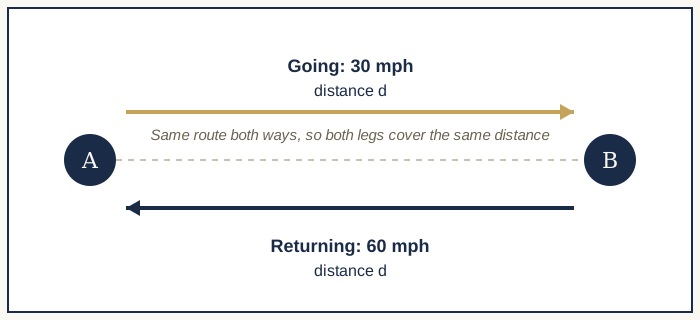
A van travels 60 miles out at 30 mph and returns along the same route at 60 mph. The temptation is to compute mph. The definition produces a different answer. The trip out takes hours, the return takes hour, and the totals are 120 miles in 3 hours:
The answer, 40, sits below 45, and the direction of the miss is predictable. The van spends two hours at the slow speed and one hour at the fast speed, so the slow speed carries more weight in the average: . That weighting is also why the answer never depends on the distance. Pick 30 miles or 120 miles for the leg and the same calculation produces 40 mph either way, which is why questions can leave the distance unstated and still have exactly one correct answer.
When averaging the speeds is safe
Equal times make the shortcut safe. Drive 30 mph for one hour and 60 mph for one hour, and the trip covers 90 miles in 2 hours, an average of 45 mph, which matches exactly. When each speed runs for the same amount of time, the speeds average cleanly.
Average speed is a weighted average in every version of this setup, and the weights are the time spent at each speed. Our guide to weighted averages covers that method in detail, and the same weighting logic shows up in mixture and score questions.
The distance-rate-time chart
The chart gives every leg one row, with columns for distance, rate, and time. Fill in what the question gives, compute the missing cell in each row from distance = rate × time, and the two totals used in the division sit in the Total row.
The round trip from above becomes:
| Distance (miles) | Rate (mph) | Time (hours) | |
|---|---|---|---|
| Going | 60 | 30 | 2 |
| Returning | 60 | 60 | 1 |
| Total | 120 | 3 |
The average speed is the total distance over the total time, mph. The Rate column gets no Total value, because rates don't add. The two totals the division uses are distance and time.
Keep the units consistent, too. If a question states one leg's time in minutes but asks for the average in miles per hour, convert the minutes to hours before totaling. A mixed-unit chart may not flag the mistake, so make the conversion a rule at setup.
Picking a workable distance
When a question gives two speeds but no distance, you can pick the distance yourself. Choose a number both speeds divide evenly, 60 for a 30-and-60 round trip, for example, and both times come out as whole numbers, which keeps the arithmetic simple. Our guide on when picking numbers beats algebra covers the broader technique and the answer-choice patterns that call for it.
The impossible second half
A classic version of this topic asks a different question. A driver wants to average 60 mph over a 120-mile trip, but traffic kept the first 60 miles to an average of 30 mph. What average speed does the second half need?
The 60 mph target over 120 miles requires 2 total hours. The first half used exactly 2 hours already, so reaching the target would require covering the remaining 60 miles in zero hours, which no finite speed can do. Versions of this question tend to offer 45 (the averaged speeds) and 60 (the original target) as answer choices, and both come from averaging speeds instead of comparing the time the target needs with the time the trip has left.
Average speed in Data Sufficiency
Data Sufficiency lives in the Data Insights section on the Focus Edition, and average speed statements tend to give the chart's information one fact at a time: one statement supplies a leg's distance, another supplies a leg's time or the trip's total time. The sufficiency question becomes whether the chart can be completed, which is the same totals logic as the Problem Solving version.
A statement that describes one leg rarely determines the average on its own, because the average needs the totals. Our guide to Data Sufficiency covers the question type in full, including the habit of listing what each statement would add to your setup before doing any arithmetic.
How much study time does average speed deserve?
A short investment usually covers it. The definition is one line, the kind of binary knowledge that belongs on a flashcard: total distance over total time, and you know it or you don't. Our guide to the types of knowledge that improve your score covers why binary topics call for a different study method than multi-week skills projects. The procedural half is the chart habit: building the table fast, converting units at setup, and picking a workable distance when the question leaves it out. Those skills come from drilling a handful of official rate questions until the setup feels automatic, and our guide on math problems with solutions covers how to study from a worked problem so the method sticks.
Then add the topic to your question-type audit, the "when I see this type, I do ___" list from our guide to breaking through a score plateau. "Average speed question: build the chart, then divide the totals" is a line that belongs on that list.
Try this one
A delivery van travels 60 miles from its depot to a warehouse at an average speed of 30 miles per hour, then returns along the same route at an average speed of 60 miles per hour. What was the van's average speed for the entire trip, in miles per hour?
(A) 30
(B) 40
(C) 45
(D) 90
(E) 120
Try this one before reading on.
The totals: 60 miles at 30 mph takes 2 hours, 60 miles back at 60 mph takes 1 hour, so the trip covers 120 miles in 3 hours.
The answer is (B).
Choice (C) is the trap worth naming: 45 comes from , the equal-time shortcut applied to times that aren't equal. The van spends twice as long at 30 mph as at 60 mph, so the average has to sit closer to 30 than 45 does. Choice (E) restates the total distance, 120, with the time part of the definition missing. Choice (D) adds the two speeds, and 90 matches nothing in the chart's columns.
FAQ
What is the average speed formula on the GMAT®?
Average speed = total distance ÷ total time. It follows from distance = rate × time, and it applies to any trip, including multi-leg trips with different speeds on each leg.
Is average speed the average of the two speeds?
Only when the times spent at each speed are equal. One hour at 30 mph plus one hour at 60 mph averages to 45 mph. Equal distances at different speeds produce unequal times, so the simple average of the speeds gives the wrong answer in that case.
What is the average speed for a round trip at two different speeds?
For equal distances at speeds and , compute total distance over total time, which works out to . A 30 mph trip out and a 60 mph trip back averages mph, not 45.
Why is the round-trip average below the average of the speeds?
The slower speed takes more time, and time is the weight in the average. Spending two hours at 30 mph and one hour at 60 mph weights the slow speed twice as heavily, and the average comes out at 40.
Do average speed questions appear in Data Insights?
Yes, as Data Sufficiency questions, which live in the Data Insights section on the GMAT® Focus Edition. Statements typically supply one leg's distance or time at a time, and the question is whether the full chart can be completed.
How do you handle minutes and hours in average speed problems?
Convert all times to one unit before totaling, usually hours when the answer is in miles per hour. The definition needs consistent units in the totals, because a mixed-unit total produces a wrong average without any visible error.
Want to learn even more?
Related reading:
- GMAT® Word Problems: A Complete Guide
- GMAT® Weighted Averages: A Complete Guide
- GMAT® Work/Rate Problems: Why Organization Matters
- How Writing Down More Improves Your GMAT® Score
- GMAT® Math Problems with Solutions: How to Use Them to Raise Your Score
- GMAT® Data Insights: A Complete Guide
For a worked example of the rate-chart habit in action, we walk through three work/rate problems in Episode 44 of our Real GMAT® Problems series ("Work/Rate Problems"), including the version of the chart we use to keep every quantity in its own column. You can search for it on Spotify, Apple Podcasts, or YouTube, where you'll also find our full catalog of strategy episodes.