"If a = -0.3, Which of the Following Is True..." — GMAT® Worked Solution
Source: Official Guide for GMAT® Review, 11th Edition
If , which of the following is true?
(A)
(B)
(C)
(D)
(E)
Try it before reading on.
Step 1: Convert to Fractions
Working with fractions makes the comparison cleaner than decimals.
Write all three values on your page. Don't try to compare them in your head.
Step 2: Convert to a Common Denominator
To compare, convert all three to thousandths:
Step 3: Order From Smallest to Largest
Now compare the numerators. Two are negative, one is positive.
- — most negative (furthest left on the number line)
- — negative but closer to zero
- — positive (furthest right)
From smallest to largest:
The answer is (B).
Why Is Larger Than
This is where most people get tripped up. When you cube a positive fraction, the value gets smaller. cubed is — smaller.
But when you cube a NEGATIVE fraction, the magnitude gets smaller (closer to zero) while the value gets LARGER (less negative).
Think of it on a number line:
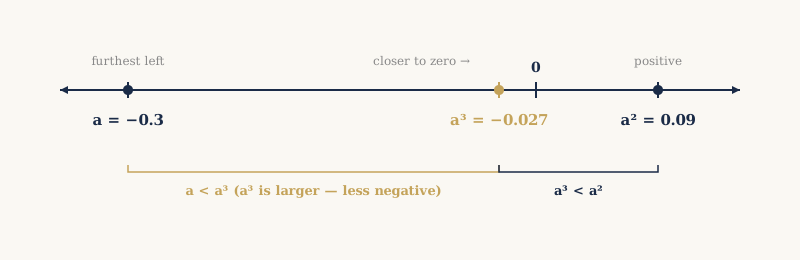
- is to the left of zero
- is also to the left of zero, but closer to it
- is to the RIGHT of
So is larger than , even though the magnitude (absolute value) is smaller.
The Trap: Why 32% Choose (E)
The elimination reasoning that works for the first three answer choices:
- is positive (negative × negative = positive), so is the largest → eliminates (C) and (D)
- is negative (negative × negative × negative = negative), so can't be the largest → eliminates (A)
That leaves (B) and (E). Both say is the largest. The difference is the order of and .
- (B) says (a cubed is larger)
- (E) says (a cubed is smaller)
The instinct: "cubing a fraction makes it smaller, so must be less than ."
That instinct works for positive fractions. It reverses for negative fractions.
When the number is negative, "smaller in magnitude" means "closer to zero" means "larger in value." .
That's why (E) is wrong and (B) is correct.
Why This Problem Matters
Over a third of test takers miss this problem. 32% — almost a third — choose (E), the same wrong answer. This isn't random error. It's a systematic trap built into how people reason about fractions and negative numbers.
The problem looks simple. One line, no word problem, no complex setup. And that's exactly why people do it in their head. They eliminate three answer choices using correct reasoning, then apply the same reasoning to the final choice — and that's where it breaks down.
The reasoning "cubing a fraction makes it smaller" is correct for positive numbers. It reverses for negative numbers. The difference between "smaller in magnitude" and "smaller in value" is the trap.
The fix: write out the actual values. , , . Compare them. The relationship is obvious on paper. It's not obvious in your head.
This problem takes about 10 seconds to solve with written computation. It takes longer than that to reason through it mentally — and the mental path has a 32% failure rate.
Want the full strategy behind this problem? Read: GMAT® Trick Questions: The Write-It-Down System
From Episode 28 of Real GMAT® Problems (The GMAT® Strategy Podcast).