
GMAT® Mixture Problems: A Complete Guide
Setting up an equation for a mixture problem makes sense. Two solutions combine into one blend, so two quantities and one unknown is a reasonable setup, and algebra produces the answer from there. That approach works, and it's the first method we'll build.
Many two-solution questions also allow a faster route. A mixture is a weighted average where the weights are the pour amounts, and that view produces a one-line solve for the target-strength questions the GMAT® tends to ask. This guide covers the table that keeps the algebra organized, the balance shortcut, the standard wrong answer in the answer choices, and how much study time the topic deserves.
What mixture questions look like
Two ingredients with different strengths become one blend, and the question asks about the result. Solutions are the classic setup: a 20% alcohol solution combined with a 50% alcohol solution, with a question about the strength of what comes out. The same calculation applies to price mixtures, two grades of nuts sold by the pound, etc.
On the GMAT® Focus Edition, these appear as Problem Solving questions in the Quant section, and the same mixture relationships can appear inside Data Sufficiency statements in Data Insights. We'll cover the Data Sufficiency version below.
The one relationship: pure amounts add
The central relationship in a mixture question is that the pure amounts add up. Pour 12 liters of a 20% solution into a flask, and the flask holds liters of pure alcohol. Pour in a second solution and its pure amount adds to the total. Because each ingredient contributes two facts (an amount and a strength) while the question usually asks about only one of them, the reliable way to organize the work is a table that keeps the two pieces separate until the final division combines them.
The table has one row per ingredient. Suppose the flask holds 12 liters of the 20% solution and you add 6 liters of the 50% solution:
| Amount (liters) | Strength | Pure amount | |
|---|---|---|---|
| Solution A | 12 | 20% | |
| Solution B | 6 | 50% | |
| Blend | 18 | ? |
Each row multiplies amount by strength to get the pure amount, and the Blend row adds each column. The blend's strength is the pure amount over the total amount:
Thirty percent. That division is the weighted average formula from our guide to weighted averages, with the strengths as the values and the pour amounts as the weights.
The balance method for two-solution questions
Plenty of mixture questions run the other direction: they give the target strength and ask for an amount. Say you have 6 liters of a 50% solution, and you want to add some amount of a 20% solution to make a blend that's 30%. The full equation works: , then two steps of distributing and collecting. The balance method can reduce that algebra to one line.
The method uses one fact about weighted averages: the blend strength must be between the two strengths, closer to the solution with the larger amount, and distance times amount has to match on both sides. In this example, 30% is 10 percentage points above 20% and 20 percentage points below 50%. The distance from 50% to 30% is twice the distance from 20% to 30%, so the 50% solution's amount must be half as large:
Twelve liters of the 20% solution. The table from the last section is also the check for this answer: plus gives pure liters in 18 total, which is the 30% blend.
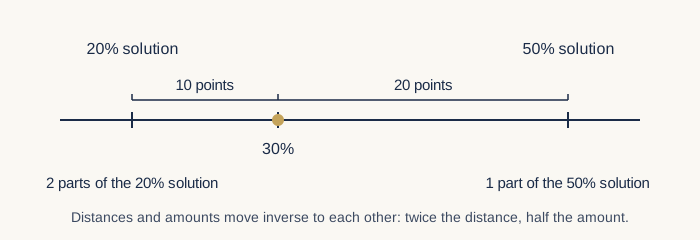
Older textbooks call this method alligation, so that name may surface if you search for extra practice. The idea is the same: distances times amounts match on both sides.
The table works on any mixture question, including versions with three ingredients or questions about totals, and it doubles as the check for the shortcut. The balance method solves the two-solution, target-strength version, which is the version that appears most often.
Price mixtures use the same table
Strengths don't have to be concentrations. Two grades of nuts at $9 and $5 per pound, blended into an 8-pound bag that sells for $6.50 per pound, use the same table with price in the strength column. The distances are $2.50 for the $9 nuts and $1.50 for the $5 nuts, so the amounts come out as 3 pounds of the $9 nuts and 5 pounds of the $5 nuts. Coffee blends and other price-per-pound setups reduce to the same table.
The averaging trap
The plain average of the two strengths is a standard wrong answer. In the 20-and-50 problem, 35 is the answer you'd get with equal amounts, and a choice like that appears on these questions often. For two strengths, equal amounts are the one case where the plain average gives the blend strength, because the blend is then the midpoint. When the amounts differ, the blend strength is closer to the strength of the solution with the larger amount.
Average speed questions contain the same kind of wrong answer, and our guide to average speed covers when averaging the two speeds is safe (only when the times match). Time supplies the weights in an average speed question; the pour amount supplies the weights in a mixture, and the weights set the result.
Mixtures in Data Sufficiency
Data Sufficiency lives in the Data Insights section on the Focus Edition, and the same mixture relationships can appear inside Data Sufficiency statements. The statements tend to supply the table's facts one at a time: one statement gives an amount, another gives a strength or the blend total, and the question is whether the statements provide enough information to answer. Sometimes that means completing enough of the table to compute the blend strength. Sometimes a comparison, such as whether the blend tops 30%, is enough.
That second version is where the balance relationship helps. Suppose a question asks whether a blend of a 20% salt solution and a 40% salt solution is more than 30% salt. A statement that the 40% solution contributed more than the 20% solution is enough on its own, because extra weight on 40% puts the blend above the 30% midpoint. Before writing an equation on a mixture DS question, compare the target strength with the two given strengths; the comparison alone sometimes answers the question.
How much study time do mixtures deserve?
Less than the core topics, unless mixtures are already a strength. Mixtures, counting, and probability tend to appear only a few times per test, so they can take more study time than that frequency justifies, which is part of why our guide to acing the GMAT® in one month recommends skipping this family when the timeline is compressed. Core topics like word problems, algebra, and percents appear far more often per point of effort, so they come first in a limited study window.
If more study time is available, the efficient approach is bounded. The pure-amount table and the balance method are both short enough to learn as flashcard knowledge, which makes them a fit for the binary-knowledge study method from our guide to the types of knowledge that improve your score. Drill a handful of official mixture questions until the setup feels automatic, then add the topic to your question-type audit, the "when I see this type, I do ___" list from our guide to breaking through a score plateau. The entry can read: "Mixture question: table, then balance check."
Try this one
A chemist has 6 liters of a 50% alcohol solution. How many liters of a 20% alcohol solution should be added to create a mixture that is 30% alcohol?
(A) 3
(B) 6
(C) 9
(D) 12
(E) 18
Try this one before reading on.
The balance method: 30% sits 10 percentage points above 20% and 20 percentage points below 50%, so distance times amount matches as , which gives .
The answer is (D).
Choice (B) assumes the two amounts should match, which would produce a 35% blend rather than a 30% one. Choice (A) inverts the ratio, adding half as much of the 20% solution as the 50% amount when the distances require twice as much. Choice (C) would add 9 liters, which produces liters of alcohol in 15 total liters, or 32%. Choice (E) restates the final volume, 18 liters, which answers a different question than the one asked.
FAQ
What is a mixture problem on the GMAT®?
A word problem in which two or more ingredients with different strengths combine into one blend, and the question asks about the strength, an amount, or the price of the result. Solutions are the classic version, and price-per-pound blends use the same math.
What is the formula for mixture problems?
The pure amounts add: each ingredient's amount times its strength, summed, equals the blend's total amount times its strength. Solving for the blend's strength is the weighted average formula with the amounts as the weights.
What is the balance method for mixtures?
A shortcut for two-ingredient problems: the blend strength must be between the two strengths, and distance times amount matches on both sides. Older textbooks call the method alligation.
When does averaging the two strengths work?
Only when the two amounts are equal, in which case the blend is the plain midpoint. Unequal amounts put the blend strength closer to the solution with the larger amount.
Do mixture problems appear in Data Insights?
Yes, as Data Sufficiency questions, which live in the Data Insights section on the GMAT® Focus Edition. Statements typically supply the table's facts one at a time, or a balance relationship that can decide a strength question without any amounts.
How much should you study mixture problems?
A bounded investment. The two methods are short, so learn them as flashcard knowledge, drill a handful of official questions, and move on. Mixtures, along with counting and probability, tend to appear only a few times per test, so they can take more study time than that frequency justifies.
Want to learn even more?
Related reading:
- GMAT® Weighted Averages: A Complete Guide
- GMAT® Word Problems: A Complete Guide
- GMAT® Average Speed: A Complete Guide
- GMAT® Ratios and Proportions: A Complete Guide
- Types of Knowledge to Improve Your GMAT® Score: Conceptual vs Procedural
- How to Ace the GMAT® in One Month
Mixtures usually appear alongside word problems and weighted averages, and both of those guides cover the setups where they show up. For the proportion method applied to a concentration question, we walk through a glucose solution problem in Episode 18 of our Real GMAT® Problems series ("Proportions"). You can search for it on Spotify, Apple Podcasts, or YouTube, where you'll also find our full catalog of strategy episodes.