GMAT® Multi-Source Reasoning: A Complete Guide
Multi-Source Reasoning is the only question type on the GMAT® built on multiple documents at once. Two or three tabs of material, a question panel alongside, and more raw information on one screen than anywhere else on the exam. The first impression is usually some version of: that's a lot.
The impression is fair, and it points at the right target. The format is the adjustment. The content underneath is the quant and verbal material you're already studying, and the approach that works is one you already know from reading comprehension. This guide covers the format, the approach, the no-partial-credit rule, and how to study for this question type without turning it into a bigger project than it is.
What Multi-Source Reasoning looks like
Multi-Source Reasoning is one of the four integrated reasoning question types inside the Data Insights section. Instead of a single block of data, you get two or three tabbed pages, and they behave like browser tabs: only one is visible at a time, so you click back and forth to see the whole picture.
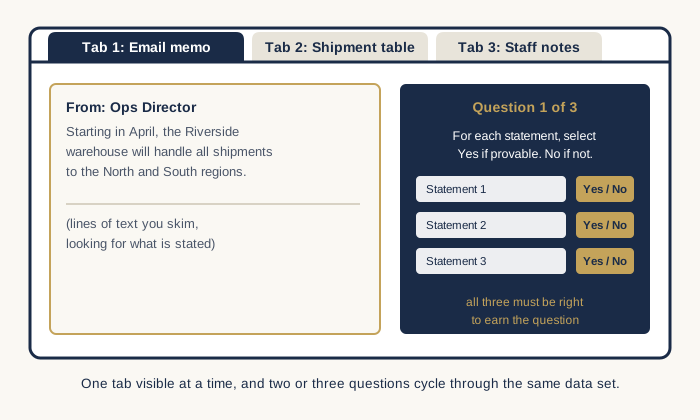
The tabs hold some mix of text, tables, and charts. An email memo in one tab and a data table in the other is a common shape, and the questions ask how the two relate.
Then there's the structural difference: two or three questions usually share the same data set. The other integrated reasoning types are one question per data set, so whatever time you spend learning a Multi-Source Reasoning tab set, that investment covers a whole batch of questions. It's the closest thing the GMAT® has to a reading comp passage with a small set of questions attached.
The questions themselves come in two flavors. Some are standard multiple choice with five answer choices. Others present three statements, and you select Yes or No for each one.
For a lot of business professionals, the setup is familiar in a completely different way. An email in one tab, a spreadsheet in another, a report you're assembling from both. That's a regular morning in plenty of offices, and it's part of why the section exists: business schools wanted a direct test of data literacy, and synthesizing information across sources is the skill.
The approach: treat it like reading comprehension
The most useful move on Multi-Source Reasoning is treating the tab set exactly like a reading comprehension passage. If you've worked through our guide to reading comprehension, the method transfers almost directly. The short version:
Do a fast scan of every tab first. You're not studying the data yet, you're building a map: what's in each tab, what kind of information lives where, and how the sources connect.
Make light notes if that helps. A few lines on your scratch pad saying which tab holds which kind of information is plenty.
Then answer from the evidence. For these questions, the tabs are the evidence.
The scan is not a careful read of every line before you look at the questions, because that's the expensive version and it burns time you'll want back. A skim that gives you the map is the goal, and you dig into specifics when a question points you at them. Our guide to guessing on Data Insights covers the question-first variation, which is the right adjustment when the clock is the bigger problem.
Evidence, not opinion
Watch the verbs on a Multi-Source Reasoning question. When it uses words like infer, suggest, imply, or support, it sounds like an invitation to speculate. It isn't. On this test, those words all point to the same standard: which answer can be proven from the evidence?
An analogy we use in coaching: suppose a colleague walks into a meeting with wet hair. In everyday life, you might reasonably guess a shower, or rain, or a swim. On the GMAT®, only two things can be proven: that the colleague has hair, and that it isn't dry. Everything else is a guess, and the test doesn't want guesses.
The tabs hand you a fixed supply of evidence, and the questions are built around answers that go beyond it. An answer choice can sound plausible and still be unprovable. When you answer from what the tabs state rather than from what seems likely, many of those traps stop working.
No partial credit, and why that helps you
The three-statement format has a hard edge: all three selections have to be right for the question to count. Two out of three is a wrong answer, same as zero out of three.
That rule sounds punishing, and it's worth flipping around, because it should change which questions you fight for. Your odds of guessing correctly are lower when a question has three independent parts, so an unsure three-statement question is a better candidate to leave and revisit than an unsure single-part one. The rule that makes these questions harder is the same rule that tells you where guessing costs least. Our guide to guessing on Data Insights sorts the statements into supported, contradicted, and not addressed, which is exactly the triage this decision needs.
Timing on Multi-Source Reasoning
The Data Insights section runs 20 questions in 45 minutes, which works out to about two minutes and 15 seconds per question. Multi-part questions are where that budget disappears, and a Multi-Source Reasoning set can run long when you get lost clicking between tabs.
Two rules keep the damage contained.
First, the three-read rule. If you've read a piece of a tab three times and it still isn't making sense, that's the signal to pick an answer, bookmark the question, and move on. The review feature lets you change your answer on up to three questions per section, so an early skip isn't a final decision. Our guide to leveraging the new GMAT® rules covers the review mechanics in detail. Our guide to when to let go of a question covers the broader skill.
Second, the map pays for itself. Two or three questions share the tabs, so the scan you do for the first question usually serves the second and third. The place time dies is re-reading the tabs from scratch for every question, which tends to happen when the first pass was a thorough read instead of a skim. Our guide to timing strategy covers pacing for the whole section.
How to study for Multi-Source Reasoning
Three things, in order.
Quant and verbal first. The content in those tabs comes from quant and verbal material, which is why the standard advice is to build those sections before specializing in Data Insights formats, and it's advice we agree with. Your quant accuracy and your reading comprehension usually do more for this question type than a dedicated drill.
Then volume. Most of the GMAT® rewards fewer problems with deeper review, and integrated reasoning is the exception. The format is the skill, and comfort with tab mechanics comes mostly from doing a lot of these questions. Just keep the review honest as you go.
Then old materials. Integrated reasoning didn't change when the Focus Edition arrived, so IR questions from GMAT® Classic prep materials, official or community-created, still work as practice for this exact format. The question types are identical; only the section around them moved. If the supply of Data Insights-specific practice feels thin, the IR archive goes back more than a decade.
As the volume accumulates, fold the type into your question-type audit, the "when I see this type, I do ___" list from our guide to breaking through a score plateau. "When I see Multi-Source Reasoning, I skim every tab, note what lives where, and answer only from the evidence" is the whole play.
Try this one
Tab 1 is a memo from an operations director that reads: "Starting in April, the Riverside warehouse will handle all shipments to the North and South regions." Tab 2 is a table of March shipments: North, 2,400 units; South, 1,750 units; East, 3,100 units.
For each statement, select Yes if the statement can be proven from the information provided. Otherwise, select No.
Statement 1: In March, shipments to the East region exceeded shipments to the North region.
Statement 2: Starting in April, the Riverside warehouse will handle shipments to the North region.
Statement 3: In March, the Riverside warehouse handled no shipments to the South region.
Try this one before reading on.
Statement 1 is arithmetic from the table: 3,100 units exceeds 2,400 units, so the answer is Yes.
Statement 2 restates the memo's own line about what happens starting in April, so the answer is Yes.
Statement 3 is the interesting one. The memo describes an arrangement that starts in April. It never mentions March, and "starting in April" isn't evidence about March in either direction. The statement is plausible, and it isn't provable, so the answer is No.
Two provables and one plausible non-provable, and all three have to land for the question to count.
FAQ
What is Multi-Source Reasoning on the GMAT®?
A Data Insights question type that presents two or three tabbed pages of information, usually a mix of text, tables, and charts, and asks two or three questions about how the sources relate. Only one tab is visible at a time.
How many questions share a Multi-Source Reasoning data set?
Usually two or three, which is what separates it from the other integrated reasoning types. Those use one data set per question, while Multi-Source Reasoning works more like a reading comprehension passage with a small question bank attached.
Do you get partial credit on Multi-Source Reasoning?
No. On the three-statement questions, all three selections have to be right for the question to count. The same all-or-nothing rule runs through the section's multi-part formats: two-part analysis questions and graphics interpretation dropdowns are scored the same way.
What does "infer" mean on the GMAT®?
On this test, infer, suggest, imply, and support all point to the same standard: provable from the evidence. They don't ask for your interpretation. If a claim can't be proven from the tabs, the correct answer is No.
How should I study for Multi-Source Reasoning?
Build quant and verbal first, because they supply the content. Then practice at volume, since the format itself is the skill, and use IR questions from the GMAT® Classic era, which work for this format because the question types didn't change.
How much time should a Multi-Source Reasoning question take?
The section allots about two minutes and 15 seconds per question, based on 20 questions in 45 minutes. Multi-Source Reasoning sets can run longer since the data set serves several questions. If a tab still isn't making sense after three reads, bookmark the question and come back.
Want to learn even more?
Related reading:
- GMAT® Data Insights: A Complete Guide
- GMAT® Reading Comprehension: How to Read for the Test
- How to Guess on GMAT® Data Insights: Elimination Tactics for Every DI Question Type
- GMAT® Timing Strategy: How to Pace Each Section
- GMAT® Data Sufficiency: How to Approach DS Questions
- When to Let Go of a GMAT® Question
Our podcast episode "GMAT® Focus Data Insights: The Complete Guide for 2024 and Beyond" walks through the whole Data Insights section, Multi-Source Reasoning included, and "What Everyone Should Know About the Integrated Reasoning Section" covers the evidence rule and where it comes from. You can listen on Spotify, Apple Podcasts, or YouTube, where you'll find our full catalog of strategy episodes.