GMAT® Two-Part Analysis: A Complete Guide
Two-Part Analysis asks you to answer one question twice. There's a prompt, then a table with two columns, then a short list of options that the two columns share, and you pick one cell in each column. The first reaction is usually some version of: two blanks means twice the work.
That's a reasonable read of the screen, and the no-partial-credit rule means the two blanks really do travel together. But the content underneath is the quant and verbal material you're already studying, the two columns usually connect through one relationship, and that relationship often does much of the solving for you. This guide covers the format, the method, and the decisions the scoring rules should shape.
What Two-Part Analysis looks like
Two-Part Analysis is one of the four integrated reasoning formats inside the Data Insights section, which pairs them with Data Sufficiency, the question type that moved over from quant. The screen has two pieces: a prompt with the setup, and a table underneath it. The table's columns are the two parts, and the rows hold the answer options, usually five or six rows, shared by both columns. The instruction above the table reads "Make only two selections, one in each column."
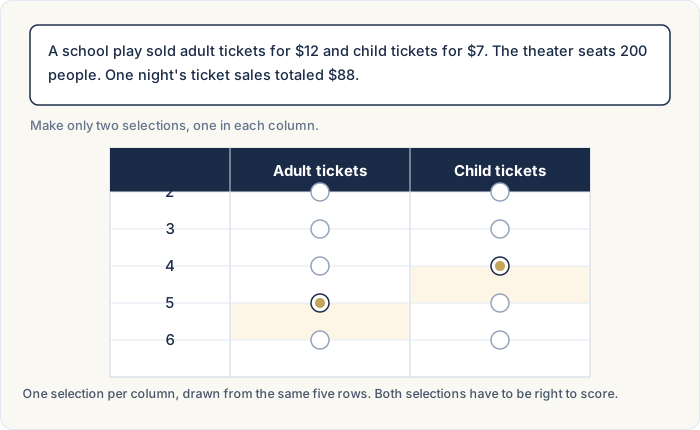
The selections work like radio buttons: one cell in the first column, one in the second, and the pair has to be right together for the question to count. Picking the correct value in one column and the wrong value in the other earns nothing, which is the same all-or-nothing rule that runs through Multi-Source Reasoning and the section's other multi-part formats.
The prompts come in two flavors. The quant flavor is a word problem with two unknowns (how many of each ticket type sold, etc.). The verbal flavor reads like a close cousin of critical reasoning: a short argument, then two columns that each ask for a different kind of statement about it.
Read for the assignment
The two-part format packs a lot of information into a small screen, and not all of it matters. On quant questions, nearly everything you're given gets used in the solve. Integrated reasoning works differently: the prompts often include information that has nothing to do with the question, and part of the skill is noticing which data you need and letting the rest sit there.
The order of operations that handles this: write down what the question is asking before you work through the data. A single line on your scratch pad naming the two blanks is plenty, and it does two jobs. It clarifies what a correct pair of selections looks like, and it turns the prompt into a filter. Once you know what you're hunting for, the facts connected to your two blanks stand out, and the rest fades into the background. Our guide to word problems covers the translation step that comes next.
When the algebra cooperates
A lot of these questions solve like any other system of equations. Say a caterer is setting up an event where 152 guests have confirmed and every seat at every table is filled. The 20 tables come in two sizes: round ones seat 6 guests, and rectangular ones seat 10. The event room's posted capacity is 180, a number the question never asks about and you don't need to solve this one.
If is the number of round tables and is the number of rectangular ones, the setup is:
Substitute into the second equation:
Two columns, one system of equations, and the same substitution move from our guide to linear equations.
When it doesn't: solve for the relationship, then test
Some Two-Part Analysis questions withhold the second equation. You get one relationship between two unknowns, which isn't enough to solve for either value alone, and the columns ask which pair of values could work. If you're used to quant questions resolving into one clean answer, the open-endedness can take a few questions to get comfortable with.
The efficient path has two moves. First, push the given information as far as it goes: write the relationship as an equation, then note anything it forces, like a remainder, a parity condition, or a range. Second, test the answer options against what you wrote, one column at a time. Blind testing is the expensive version: with five options per column, there are 25 possible pairs, and the relationship usually cuts that down to a handful in one pass. Our guide to guessing on Data Insights applies the same narrowing logic when the clock is the bigger problem.
No partial credit, and what it changes
Both selections have to be right. One right and one wrong scores as a wrong question, the same rule that governs every multi-part format in the section.
It sounds strict, and it has a practical upside. When you're low on time and unsure about a question, an unsure two-part question is usually a better candidate to leave and revisit than an unsure single-answer one, because your odds of guessing the entire thing correctly are lower. The review feature lets you change answers on up to three questions per section, so an early bookmark isn't a final decision. Our guide to when to let go of a question covers the broader judgment.
Timing and the calculator
The Data Insights section runs 20 questions in 45 minutes, which works out to about two minutes and 15 seconds per question, and multi-part questions are where that budget comes under pressure. A Two-Part Analysis that turns into a long algebra grind is usually a signal to reset and re-read what the two columns are asking, because the grind tends to mean a shortcut in the relationship went unnoticed. Our guide to timing strategy covers pacing for the whole section.
The on-screen calculator is available throughout the Data Insights section, these questions included. It can speed up arithmetic, but most of the work on a Two-Part Analysis is setting up the relationship between the columns, and setting up is reading and algebra, not calculation. Our guide to the calculator rules covers what the tool can and can't do.
How to study for Two-Part Analysis
Three things, in order.
Quant and verbal first. These questions reuse the content from those sections, so there's no new math to learn and no new verbal technique. The prep you're already doing is the prep they draw on.
Then format practice at volume. Most of the GMAT® rewards fewer problems with deeper review, and integrated reasoning is the exception: the format itself is the skill, and comfort with the two-column rhythm comes mostly from doing a lot of these questions. Old integrated reasoning questions from the GMAT® Classic era work fine for this, because the integrated reasoning formats didn't change when the Focus Edition arrived. Just keep the review honest as you go.
Then the audit. Fold the type into the question-type audit from our guide to breaking through a score plateau: "when I see a two-column table, I write down what the two blanks are asking, find the relationship, and test one column against it."
Try this one
Practice question — Two-Part Analysis
A school play sold adult tickets for $12 and child tickets for $7. The theater seats 200 people. The box office log from one night shows $88 in ticket sales but doesn't record how many tickets of each type were sold.
Make only two selections, one in each column.
| Adult tickets | Child tickets | |
|---|---|---|
| 2 | ||
| 3 | ||
| 4 | ||
| 5 | ||
| 6 |
Reveal answers
Adult tickets: 5. The only adult value that leaves a multiple of 7 when its sales are subtracted from $88.
Child tickets: 4. Five adults account for $60, and the remaining $28 is exactly 4 child tickets.
Try this one before reading on. Pick one value in each column, then keep going.
The relationship is one equation: , where is adult tickets and is child tickets. One equation and two unknowns, and that's the design: no single algebraic move hands you both values.
Push it as far as it goes. Whatever is, the amount has to come out to , a multiple of 7. So test the adult column's five options: for , the leftover runs , and exactly one of those is a multiple of 7. That pins , and fills the child column in the same stroke.
Five checks instead of 25 combinations, and the 200-seat theater never entered into it.
FAQ
What is a two-part analysis question on the GMAT®?
A Data Insights question type that presents one prompt and a table with two columns of answer options, usually five or six rows, shared by both columns. You select one option in each column. The content comes from quant word problems, statistics, or critical-reasoning-style arguments.
How many answers do you select on a two-part analysis?
Two, one per column. The instruction reads "Make only two selections, one in each column," and both selections have to be right for the question to count.
Do you get partial credit on two-part analysis questions?
No. One right selection and one wrong selection scores as a wrong question. It's the same all-or-nothing rule the section's other multi-part formats follow.
Can you use the calculator on two-part analysis?
Yes. The on-screen calculator is available throughout the Data Insights section. It can speed up arithmetic, but most of the work on these questions is setting up the relationship between the two columns.
Are two-part analysis questions quant or verbal?
Both flavors appear. Quant questions are usually word problems with two unknowns; verbal questions read like critical reasoning with a second column attached. Neither tests content beyond what the quant and verbal sections cover.
How do you solve two-part analysis questions?
Write down what the two columns are asking, pull the data from the prompt that connects to them, and translate it into an equation or relationship. If the algebra solves cleanly, solve. If it doesn't, use the relationship to test one column's options, which usually pins the other column in the same pass.
Want to learn even more?
Related reading:
- GMAT® Data Insights: A Complete Guide
- GMAT® Multi-Source Reasoning: A Complete Guide
- GMAT® Linear Equations: A Complete Guide
- GMAT® Word Problems: A Complete Guide
- How to Guess on GMAT® Data Insights
- Calculator on the GMAT®? Yes, But Only for Data Insights
Our podcast episode "GMAT® Focus Data Insights: The Complete Guide for 2024 and Beyond" walks through the whole Data Insights section, Two-Part Analysis included, and "What Everyone Should Know About the Integrated Reasoning Section" covers where these questions come from. You can listen on Spotify, Apple Podcasts, or YouTube, where you'll find our full catalog of strategy episodes.